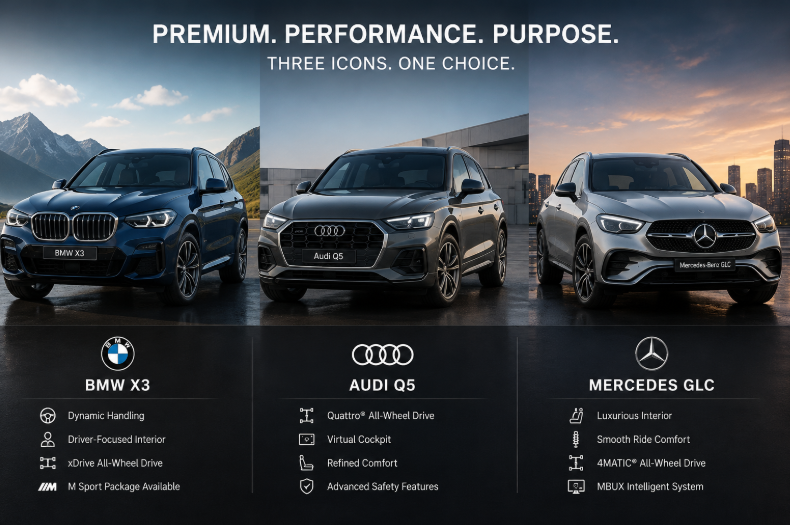
BMW X3 vs. Audi Q5 vs. Mercedes GLC: Which Compact Luxury SUV Wins in 2026?
The compact luxury SUV segment is the most competitive in the market. BMW, Audi, and Mercedes each sell tens of thousands of these every year, and for good reason — they get the formula right. But they get it right in different ways, and which one is best depends entirely on what you're actually looking for.
Here's an honest comparison of all three from the team at BMW of Bridgewater, NJ.
The Short Answer
If driving dynamics matter to you, the X3 wins. If you want the most refined, hotel-lobby interior, the GLC wins. If you want something in between with a strong tech story, the Q5 is a reasonable choice. But none of that is the whole picture — keep reading.
BMW X3 — Built to Be Driven
The X3 has always been the driver's pick in this segment, and the 2026 version continues that tradition. The steering is weighted and communicative in a way the competitors aren't, the chassis is tuned for engagement without being harsh, and the powertrain options — from the efficient sDrive30i to the 510-horsepower X3 M Competition — cover every appetite.
The interior is clean and well-executed. BMW's iDrive system, now running on a curved display setup, is among the most intuitive in-vehicle interfaces available. Rear seat space is competitive, cargo room is class-leading at 28.7 cubic feet behind the rear seats, and standard driver assistance features are comprehensive.
Where the X3 stands out most is how it feels on real roads. On the highway it's planted and quiet. On a back road it responds with a precision that neither the Q5 nor the GLC can match. For drivers who care about that — and many BMW buyers do — it's not close.
Best for: Drivers who want an SUV that genuinely rewards behind the wheel. Buyers trading up from sporty sedans. Anyone planning to hold onto it long-term and values resale strength.
Audi Q5 — The Middle Ground
The Q5 sits between the X3 and GLC in nearly every meaningful category. Its interior is excellent — Audi's Virtual Cockpit and MMI interface are polished, materials quality is high, and the cabin has a cool, precise feel that some buyers prefer to the warmer German aesthetic of the other two.
Ride quality leans slightly softer than the X3, which some buyers will prefer. The standard quattro all-wheel drive system is well-regarded. The plug-in hybrid Q5 55 TFSI e is worth considering if you have a way to charge at home — it offers meaningful real-world electric range for daily commuting.
The Q5's weakness is that it doesn't quite excel at any one thing. It's not as engaging to drive as the X3, not as opulent inside as the GLC, and not as recognizable on the road as either. For buyers who want a solid, uncontroversial choice with strong depreciation numbers, that's fine. For buyers who want something that makes them excited to get in the car, it may fall short.
Best for: Buyers who want balance above all else. Q5 plug-in hybrid for those with daily commutes under 30 miles and home charging.
Mercedes GLC — The Interior Story
If you've been inside a 2026 GLC, you know why people buy it. The cabin is stunning — the MBUX Superscreen stretches across the dashboard, the materials feel genuinely premium, and the ambient lighting system creates an atmosphere that the other two can't match. For buyers who spend a lot of time sitting still in traffic, or who want their car to feel like a retreat, the GLC delivers.
The ride quality is the softest of the three, which is a deliberate choice. Mercedes tunes the GLC for comfort over cornering, and for many buyers that's the right call. The standard 4MATIC all-wheel drive is well-suited for New Jersey winters. The GLC 350e plug-in hybrid is one of the stronger EV options in the segment.
The downsides: the GLC's infotainment relies heavily on the touchscreen and voice commands, which some drivers find distracting. Driving dynamics are the least engaging of the three. And it tends to carry a higher price of entry for comparable equipment levels.
Best for: Buyers who prioritize interior ambiance. Passengers as much as drivers. Anyone stepping down from an S-Class who wants a smaller footprint without giving up the feeling.
Head-to-Head: The Numbers
Cargo space: X3 leads at 28.7 cu ft behind rear seats. GLC at 23.7 cu ft, Q5 at 25.1 cu ft.
Base price (2026 est.): X3 from ~$48,000 / Q5 from ~$46,500 / GLC from ~$49,500
Powertrain options: X3 has the widest range, from efficient 4-cylinder to full M Competition. GLC and Q5 both offer compelling plug-in hybrid variants.
Resale value: BMW and Mercedes trade closely for top resale in this segment. Audi typically depreciates faster, which matters if you plan to sell or trade within five years.
The Bottom Line
All three are excellent vehicles. The choice comes down to what you're optimizing for. Driver engagement points to the X3. Interior luxury points to the GLC. The Q5 is the rational choice when nothing else on the list wins outright.
At BMW of Bridgewater, we carry the full X3 lineup — including X3 M and X3 M Competition — and can put you in one for a test drive that will answer more questions than any spec sheet. Call us at 908-287-1800 or visit bmwofbridgewater.com to browse current inventory.